
7 Questions to Answer Before Making or Renewing a GPU Decision
On this page
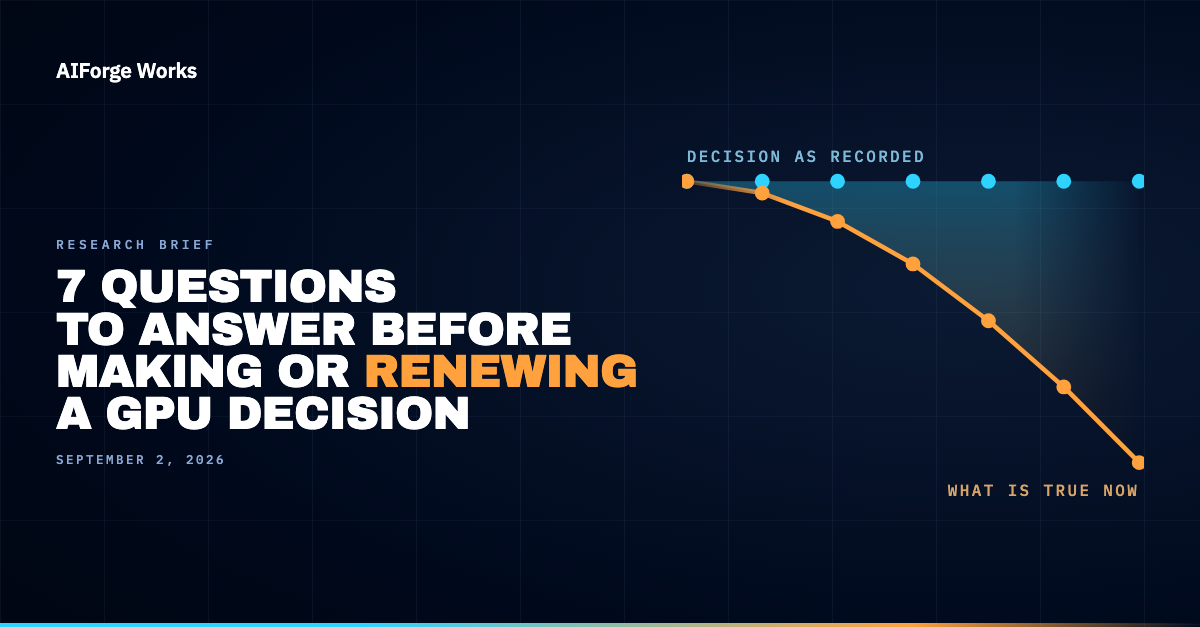
A GPU commitment is made once and may live for years. The research behind it reflected the evidence available on the day the decision was made, and it started aging immediately. Six months later the questions are different, and many teams find they have difficulty answering them. Here are seven key GPU decision questions, and what it takes to answer each one.
The meeting
The renewal is six weeks out. Someone pulls up the slide deck from last spring, which names a GPU family, a provider, and a commitment term, and asks a reasonable question: Why did we choose this?
The person who ran the analysis has left the team. The comparison lives in a spreadsheet that multiple people have since edited with no version control. The deck shows the conclusion, not the research or the reasoning. Somebody remembers a concern about regional capacity, though not whether it was ever resolved.
Nothing was done wrong here. No one was careless. The decision was well made, with good, thorough analysis at the time, by people who knew what they were doing. It simply wasn't recorded in a form that survives the people who made the decision.
Engineering solved this for itself years ago. Architecture Decision Records exist because teams learned that six months after choosing a database, nobody remembers what was rejected or why. The same discipline is not yet consistently applied to AI infrastructure spend, even though the sums can be substantial and the commitments highly variable.
Below are the questions a GPU decision record must be able to answer.
1. What did we decide?
Harder than it sounds. "We went with Provider A" is an outcome, not a researched decision.
A decision statement includes what was considered and rejected. Choosing a provider for a training workload in a specific region on a one-year commitment, over two named alternatives with documented pricing and support quotes, is a documented, reviewable decision. The name of a vendor is only a result. A result can't be re-examined, because it doesn't record the analysis or the facts that drove the decision.
If the record doesn't say what you turned down and why, a future reviewer has no way to tell whether the choice was close or obvious, or even who the other contenders might have been.
2. Why did we decide on Provider A?
Reasoning decays faster than anything else in the file.
Numbers persist, because they're in the spreadsheet. Rationale usually doesn't get written down at all, because at the time it's obvious to everyone in the room. Six months later, the room is likely different as decision makers change over time. What survives is a conclusion with no argument attached, which is indistinguishable from an arbitrary choice.
Three sentences documenting the details of a decision written on the day it was made are worth more than a full reconstruction attempted months later.
3. What evidence supported it, and how old is that evidence now?
Every input had a date. A published rate, a regional availability page, a comparison run: each was true as of a particular moment in time. None of them announce when they stop being true.
This question often goes unanswered, because evidence is usually recorded as a value rather than as a value plus a date. "Provider B was 20% higher" is not a durable statement. "Provider B's published (or quoted) one-year commitment rate for configuration Alpha was 20% higher as of March 14, 2026" is one, and it tells a future reader exactly how much weight to give it.
4. Which assumptions were confirmed, and which stayed uncertain?
Every decision rests on things somebody verified (or should have verified). A missing verification does not necessarily mean there was a failure to verify. It may simply never have been documented. Verifying every facet of a deployment is difficult, and for some things near impossible: future GPU cost shifts, future vendor coverage and availability are very hard to predict in today's market.
The failure is losing track of what was certain at decision time and what was not. Later, the responsible team needs to look back, confirm what held, and project costs and services forward. That only works if the record clearly distinguishes one from the other.
Watch for what might be called assumption laundering: an open question, repeated often enough, quietly becomes a settled fact. Somebody said capacity in that region looked tight. Nobody confirmed it. Six months later it's cited as a reason the decision was correct.
Mark each assumption confirmed or open at the time you make the decision, and there is far less room for assumption laundering later.
5. What did we agree would make us reconsider at renewal?
Many teams have no explicit answer to this, so reconsideration often arrives through one of three paths: an operational crisis, a material budget change, or a calendar date.
An operational crisis is the worst time to re-decide. A material budget change is a legitimate trigger, and a scheduled review is a useful backstop, but neither should substitute for decision-specific conditions. The goal is to avoid re-deciding under pressure, or waiting for an administrative date when the evidence changed earlier.
The alternative is naming the conditions in advance, while you're thinking clearly and have no stake in the answer. If our workload grows past this size. If a comparable option appears in this region. If the rate we benchmarked against moves more than this much. Written down on the day the decision is ratified, these are consistent, pre-agreed reasons to audit your workload cost and performance. Reconstructed under pressure, they're far less objective, shaped by whatever is currently on fire, with none of the original decision's clear context to steer them.
6. Has the infrastructure changed, or has your workload drifted?
When a decision stops fitting, teams reach for the market explanation first: prices moved, new silicon landed, a provider changed its terms. Sometimes that's right. Telling the four cases apart matters because each needs a different response.
| What moved | How you'd know | What to do |
|---|---|---|
| The market | Prices moved, new silicon landed, or a provider changed its terms, while the original workload baseline still describes what you run. | Re-run the comparison against the original workload baseline. |
| Your workload | The job you sized for was fine-tuned and planned to run twice a week; it's now a continuous pipeline running daily. Batch sizes changed, inference overtook training, or a framework switch changed the memory profile. | Update the workload specification first, then re-run the comparison. Otherwise you're comparing against a specification that no longer describes what you run: a sizing problem disguised as a pricing problem. |
| The catalog's description | A provider restructured its listings, renamed configurations, or removed an entry in one region while keeping it in another. The comparison can shift even when the underlying option did not, though a real change can hide inside that churn. | Separate genuine movement from cataloging noise, reconcile the listing against the prior catalog evidence, and label the catalog change separately. This is work worth handing to someone who regularly watches the catalogs. |
| The comparison method | The way figures were made comparable changed, a source was corrected, or a coverage gap appeared, even though neither the provider nor the workload moved. | Have whoever produced the comparison document and label the method, source, or coverage change separately before anyone reads it as a market change. |
The infrastructure is exactly what you chose, and it's no longer what you need.
A record that captured the workload as it was, including the scope, the shape, and the assumptions about growth, makes the comparison substantially faster and more defensible. Without one, you're arguing from memory about what the job used to look like.
7. Did we reaffirm this on purpose, or did we simply never look again?
The uncomfortable question.
Silence is not a decision confirmation.
A decision that nobody has escalated looks identical from the outside to a decision that has been carefully monitored and found to still hold. Both produce no alarms. Only one of them is actually being managed.
Many organizations struggle to tell which state they're in for a given commitment, and the sums involved in today's GPU infrastructure make that an expensive thing not to know.
What a decision record needs to contain
You don't need a product for this. A shared document works, as long as it holds the following, is tracked, versioned with attribution, and stays within reach:
-
An owner. A named person, not a team.
-
The decision, and what was rejected. The alternatives are part of the record.
-
The rationale and acceptance criteria. Why the selected path won, why the alternatives did not, and what success is expected to look like.
-
The scope. Which workload, which GPU family, which regions, which commercial terms it covers.
-
The date it matters by. A renewal date, a target date, or a horizon.
-
The evidence, with sources, dates, and the method used. What was compared, who compared it, where the data came from, when it was captured, how it was calculated, and where it was saved.
-
Assumptions marked confirmed or open. Explicitly separated and saved.
-
The conditions that would make you look again. Written down at decision time, long before you need them.
-
Confirmation that the above is right. From the owner, at the time.
The test is simple: hand it to someone who wasn't in the room and ask them to explain the decision back to you. If they can, it's a record. If they can only tell you the outcome, it's a receipt.
Where this fits
The GPU Decision Review that AIForge Works performs produces a Decision Brief that serves as the starting record for a single decision: what's being decided, the current path and the alternatives considered, the comparable public-market context with the date that evidence was captured and the calculation behind it, the rationale, the limitations, the questions still requiring a provider's answer, and a next action. It is a dated record, readable by both the technical and the commercial side of the table. It remains a starting record rather than a finished governance process: it does not yet carry the conditions you agreed would send you back to the table, and it does not keep itself current.
What a pricing tool gives you, ours included, is evidence. It isn't a decision. File the evidence and call it a decision, and you end up with a record of what the catalogs showed, not of what you decided or why.
If you'd rather build your own, build your own. The seven questions work regardless of what produces the answers. The avoidable failure is a decision that was well made, thinly recorded, and quietly assumed to still be true.
Author: Bobby Clay, Founder, AIForge Works, www.aiforge.works
Evidence boundary. This article describes a documentation practice, not a market claim; it contains no pricing figures. Where AIForge Works analysis is referenced, it is built from dated public-catalog and provider-specification evidence: not a live quote, not proof of availability or orderability, and not a savings guarantee. Verify current pricing, capacity, terms, and fees with the provider before acting.